
Posted At: Jun 12, 2026 - 71 Views

Projector Lens Throw Ratio: A B2B Engineering Guide
The projector lens determines throw ratio, image quality, and BOM cost — and is one of the most precision-sensitive components in any projector. For B2B buyers, projector lens throw ratio selection affects every aspect of the user experience, from installation flexibility to retail price positioning. This engineering guide explains how throw ratio works, lens types, and how to spec the right lens for OEM projectors.
What Throw Ratio Means
Throw ratio is the relationship between throw distance (projector lens to screen) and image width:
Throw Ratio = Throw Distance / Image Width
A 1.2:1 throw ratio means the projector must be 1.2 units away from the screen for every 1 unit of image width.
For a 100" diagonal screen (16:9):
- Image width: 87" (~2.2 meters)
- 1.2:1 throw: 2.64 m (~8.7 ft) from screen
- 0.4:1 throw: 0.88 m (~2.9 ft) from screen
Common throw ratio categories:
| Classification | Throw Ratio | Common Use |
|---|---|---|
| Ultra-short throw (UST) | < 0.4:1 | Living room TV replacement, window display |
| Short throw | 0.4:1 – 0.8:1 | Classroom, conference room |
| Standard | 1.0:1 – 1.5:1 | Home theater, conference room |
| Long throw | 1.5:1 – 2.5:1 | Large venue, lecture hall |
| Ultra-long throw | > 2.5:1 | Cinema, stadium |
How to Calculate Image Size and Distance

On the high-brightness side, the GP98 12400 Lumens Smart Projector for Meeting Rooms is our flagship reference platform for ODM partners—laser-phosphor light source with a sealed optical block.
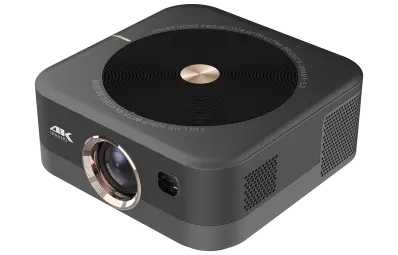
Distributors evaluating the B2B projector market can reference our GP94C Android Smart Projector for Home Theater—a production-validated platform covering Android 9 · 500 ANSI · Built-in Speakers, suitable as an OEM/ODM starting point.
Quick reference for a 16:9 screen:
| Screen Size (diagonal) | Image Width | 1.2:1 Throw | 0.4:1 Throw | 0.23:1 Throw (UST) |
|---|---|---|---|---|
| 60" | 1.33 m | 1.6 m | 0.5 m | 0.31 m |
| 80" | 1.77 m | 2.1 m | 0.7 m | 0.41 m |
| 100" | 2.21 m | 2.65 m | 0.88 m | 0.51 m |
| 120" | 2.66 m | 3.2 m | 1.06 m | 0.61 m |
| 150" | 3.32 m | 4.0 m | 1.33 m | 0.76 m |
Lens Types and Design
Standard Throw Lens (1.0:1 – 1.5:1)
Design characteristics:
- Multi-element glass (6–8 elements)
- Aspherical elements for distortion correction
- Focal length: moderate (10–25 mm depending on DMD)
- Relative simple mechanical mount
- Standard lens manufacturing processes
- Tolerances: ±0.05 mm typical
- Cost: $5–$15 per unit in volume
Short Throw Lens (0.4:1 – 0.8:1)
Design characteristics:
- More complex (8–10 elements)
- Larger front element for wide-angle capture
- Tight mechanical alignment required
- Distortion correction more critical
- Specialized optical houses
- Tolerances: ±0.02 mm typical
- Cost: $25–$60 per unit in volume
Ultra-Short Throw (UST) Lens (< 0.4:1)
Design characteristics:
- Freeform or large aspheric elements
- 10+ elements with complex surfaces
- Largest front element (often > 100 mm diameter)
- Tilted/specialized optical path to minimize distortion
- Specialty optical houses only (Young Optics, Coretronic, Appotronics)
- Tolerances: ±0.01 mm typical
- Cost: $60–$150 per unit in volume
Lens Quality Factors
Image quality depends on lens quality:
Resolution (MTF)
- Modulation Transfer Function measures lens sharpness
- Higher MTF = sharper image across the field
- Premium lenses achieve > 50% MTF at 50 lp/mm
Distortion
- TV distortion (barrel/pincushion) should be < 1%
- For UST lenses, distortion correction is critical
- Software correction can compensate up to a point
Chromatic Aberration
- Different colors focus at different distances
- ED (extra-low dispersion) glass reduces this
- Critical for sharp text in office / education
Vignetting
- Image brightness falls off at corners
- Should be < 30% for consumer projectors
- Worse in wide-angle (short throw) designs
Lens Mount Considerations
For OEM buyers, lens mount affects assembly:
Fixed Lens
- Lens permanently mounted in housing
- No zoom or focus adjustment (or only motorized)
- Lowest cost, simplest assembly
- Used in most consumer projectors
Manual Zoom/Focus
- Manual zoom ring and focus ring
- User-adjustable
- Slightly higher BOM cost
- Limited to standard throw
Motorized Zoom/Focus/Lens Shift
- Zoom, focus, lens shift all motorized
- Critical for installation flexibility (commercial)
- Higher BOM cost (motors + drive electronics)
- Used in commercial and premium home
Throw Ratio vs Brightness Trade-off
Shorter throw = wider-angle lens = less light per unit area = lower perceived brightness:
| Throw Ratio | Relative Brightness |
|---|---|
| 0.23:1 (UST) | 70–85% of standard throw |
| 0.4:1 | 85–95% |
| 1.2:1 (standard) | 100% (baseline) |
| 2.0:1 (long) | 100–110% (slightly higher) |
Optical Engine Integration
The lens integrates into the optical engine via:
Lens Barrel Mount
- Lens mounted in metal barrel
- Barrel attached to optical engine housing
- Precision alignment via set screws or shims
- Tolerance: ±0.05 mm typical
Focus Mechanism
- Manual: focus ring rotates lens elements
- Motorized: gear-driven focus motor
- TOF laser: autofocus using distance measurement
Zoom Mechanism (Optional)
- Movable lens group for zoom
- Mechanical cam or motorized drive
- Limited to standard throw lenses
Lens Suppliers
Major projector lens suppliers globally:
| Supplier | Country | Specialties |
|---|---|---|
| Young Optics | Taiwan | UST, short throw, mainstream |
| Coretronic | Taiwan | Mainstream, UST, large venue |
| Appotronics | China | UST specialist, ALPD technology |
| Phoenix Optical | China | Standard throw, value |
| Sekonix | Korea | Standard throw, automotive |
| Epson | Japan | 3LCD proprietary lenses |
| Sony | Japan | LCoS proprietary lenses |
Lens Selection for OEM Projects
Decision framework:
Standard Consumer (1080p, 800–1,500 ANSI, $300–$500 retail)
- Standard throw lens (1.2:1)
- Fixed focus or motorized focus
- $5–$15 lens cost
- Wide supplier availability
Premium Consumer (4K, 2,000+ ANSI, $800–$1,500 retail)
- Standard or short throw lens
- Motorized focus + zoom
- $20–$60 lens cost
- Premium lens suppliers
Home Theater UST (4K laser, $2,500+ retail)
- UST lens (< 0.4:1)
- Fixed focus (mounted in specific position)
- $80–$150 lens cost
- Limited to specialist suppliers
Conference Room (1080p, 3,000+ ANSI)
- Standard throw with motorized zoom + lens shift
- $30–$50 lens cost
- Commercial lens suppliers
Classroom Short Throw
- Short throw lens (0.4:1)
- Fixed or motorized focus
- $25–$50 lens cost
- Education-focused suppliers
Lens Specification Checklist
When specifying lens in your RFQ:
LENS SPECIFICATION
Throw ratio: ____ : 1
Image size: ____" to ____" diagonal
Focus: manual / motorized / TOF autofocus
Zoom: none / manual / motorized (if motorized, zoom ratio)
Lens shift: none / vertical / vertical + horizontal (if motorized, range)
F-number: ____ (aperture)
Focal length: ____ mm
Image circle: ____ mm (must cover DMD + XPR shift range)
MTF: ____ % at ____ lp/mm
Distortion: < ____ %
Vignetting: < ____ %
Operating temperature: 0–45°C
Supplier: [specified or open]
Reference design availability
Common OEM Mistakes
Five pitfalls:
- Wrong throw ratio for use case — classroom projector with 1.5:1 throw (shadow problem)
- Insufficient image circle — XPR shift exceeds image circle, edge artifacts
- Poor distortion correction — visible curvature, software fix insufficient
- Wrong F-number — too slow (dim image) or too fast (depth of field issues)
- No thermal compensation — focus drifts as projector warms up
What We Recommend for Projector Lens Throw Ratio OEM
- Standard throw (1.2:1) for mainstream consumer — best balance
- Short throw (0.4:1) for classroom / education — eliminates shadow
- UST for premium home theater — living room TV replacement
- Motorized zoom + lens shift for commercial — installation flexibility
- TOF autofocus for portable / mini — modern consumer expectation
- Partner with factory with established lens supplier relationships
Conclusion
Projector lens throw ratio selection affects installation flexibility, image quality, and BOM cost. For OEM buyers, the right choice depends on target use case and retail price band. Partner with factories that have established lens supplier relationships for reliable sourcing.
💼 Need projector lens / throw ratio OEM guidance?
Request a Free Quote | View Product Catalog
We support standard, short throw, and UST lens configurations across our projector catalog. Engineering team will recommend the right lens for your use case within 24 hours.
