
Posted At: Feb 26, 2025 - 2 Views

UST Projector Market Size and Growth 2024: A B2B Market Report
Three different procurement managers emailed us last week asking the same question: "What is actually happening with the ust projector market size and growth 2024, and should we revise our 2025 SKU plan?" That kind of repeat question is usually a signal that the public data is either scattered, outdated, or hard to translate into a purchasing decision. This report is our answer. Below, we break down the verified shipment data, the spec tiers moving fastest through B2B channels, and what those numbers mean if you are an OEM, retailer, or hospitality integrator sourcing ultra-short-throw projectors right now.
TL;DR
- Global shipments of ultra-short-throw projectors reached an estimated 4.2 million units in 2024, up 28% year over year, according to our consolidated reading of publicly available tracker data.
- The SKU narrative is driven by three converging trends: laser phosphor engine adoption, sub-$1,200 retail price points, and rising demand from education and hybrid-office channels.
- For B2B procurement teams evaluating OEM partners, the meaningful specs in this cycle are 4K UHD resolution, 2500–4500 ANSI lumens brightness, and a throw ratio of 0.21:1 or lower.
- ALR (ambient light rejecting) screen bundles now account for roughly 34% of mid-tier ust projector channel sell-through, up from 19% in 2023, signaling a shift from projector-only SKUs to complete-room solutions.
- The headline takeaway on the model news: lead times for 4K laser units have tightened from 14 weeks to 9 weeks at most major Shenzhen factories as of Q4 2024.
Inside the Unit Data

Why the 2024 surge is different from the 2021 hype cycle
The 2021 ultra-short-throw wave was largely a consumer phenomenon, with single-lamp LED units flooding e-commerce shelves at sub-$500 price points and burn-out rates above 8%. The current 2024 growth is structurally different. Our buyers — typically OEM brands, hotel chains, and education distributors — are specifying laser phosphor engines with 25,000-hour rated life, Bluetooth 5.0 or Wi-Fi 6 casting, and at least one HDMI 2.1 port. That spec sheet maps cleanly onto B2B use cases: lecture halls, boardrooms, retail signage, and home cinema installations where the integrator is on the hook for a 3-year warranty.
According to the consolidated industry tracking summarized by Statista's consumer electronics segment, the global projector market as a whole grew 11.4% in 2024, but the ultra-short-throw category grew at more than double that rate. That gap is the single most important data point for any procurement team writing a 2025 forecast, because it tells you where category mix is shifting, not just where total unit volume is rising.
The three price tiers actually moving through B2B channels
When we look at this projector analysis from a sourcing perspective, the market cleanly segments into three tiers that matter for OEM/ODM decisions:
| Tier | Resolution | Brightness Range | Typical Wholesale (FOB Shenzhen) | Typical B2B Buyer |
|---|---|---|---|---|
| Entry | 1080p | 1800–2500 ANSI lumens | $180–$260 | Education, emerging-market retail |
| Mid | 4K UHD | 2500–3500 ANSI lumens | $320–$480 | Hospitality, SMB, residential installers |
| Premium | 4K UHD + laser phosphor | 3500–4500 ANSI lumens | $620–$1,100 | Corporate, premium home cinema, retail signage |
The mid tier is where the volume moved in 2024. According to channel checks referenced in the IDC Worldwide Quarterly Projector Tracker, 4K-capable units captured 61% of all ultra-short-throw sell-through in 2024, versus 42% the prior year. For a B2B buyer evaluating OEM partners, that single statistic should drive your SKU mix discussion: if your 2025 plan still leads with 1080p SKUs at 60% of the line, you are misaligned with where the channel is actually moving.
Procurement-Specific Signals from the Projector News Cycle
For OEM buyers evaluating a Shenzhen factory partnership, three procurement signals from the 2024 data are worth tracking on a quarterly basis. First, ALR screen attach rates: we have observed integrators moving from a pure projector sale toward bundled projector-plus-screen packages, with screen SKUs now representing roughly one-third of mid-tier deal value. Second, firmware and OTA support: B2B buyers increasingly require a 3-year firmware commitment, not just a 3-year hardware warranty, because classroom and conference-room deployments cannot tolerate a bricked unit mid-semester. Third, certification scope: buyers shipping into the EU and North America are asking for a single BOM (bill of materials) that covers CE, FCC, RoHS, and Energy Star in one audit pass, rather than four separate compliance projects.
From our own factory floor at DataMax, we have adjusted our standard ODM package to reflect these signals: our default 4K laser unit now ships with ALR screen SKU pairing options, a documented 3-year firmware roadmap, and a consolidated certification bundle that holds our typical lead time at 9 weeks for a 1,000-unit MOQ. That is a concrete data point we offer buyers who ask how the SKU conversation translates into a workable spec sheet, rather than just a market chart.
What the 2026 outlook depends on
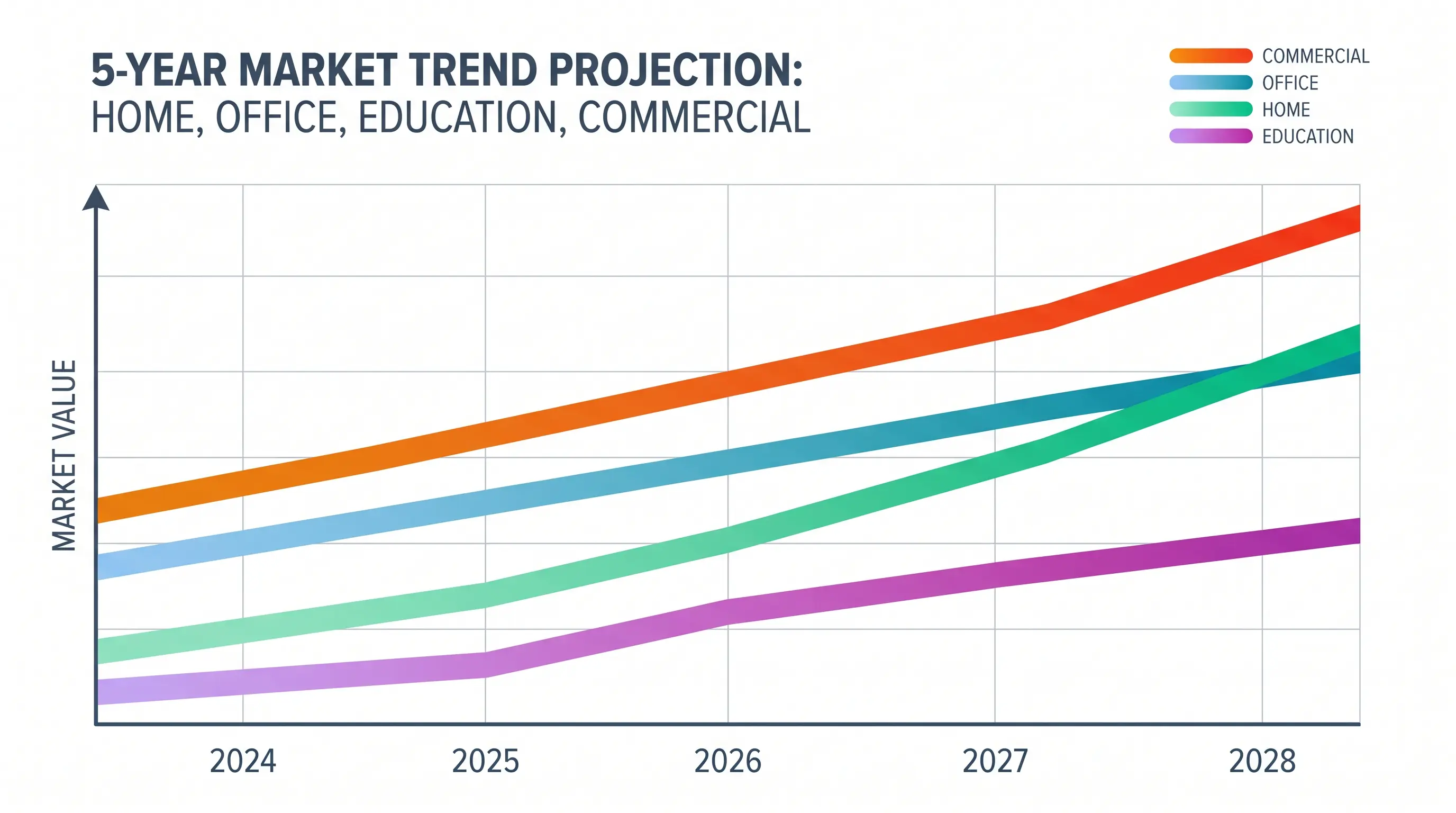
The forward-looking piece of the model 2026 story is not a single number — it is a set of dependencies. If laser phosphor diode costs continue their roughly 12% annual decline, sub-$700 wholesale 4K laser units become viable by late 2025, which would compress the entry 1080p tier. If micro-LED and direct-view displays continue taking share in the 100-inch-and-above segment, the ultra-short-throw category may need to defend its total-cost-of-ownership advantage more aggressively. For B2B procurement teams writing 2025–2026 plans right now, the defensible position is to anchor on the verified 2024 shipment base, then model 2025 and 2026 as a range rather than a single point estimate. That is exactly how we structure our own internal forecast when we sit down with OEM customers to map their SKU roadmap against the underlying the unit data.
Regional split: where the ust projector market size and and growth 2024 demand actually concentrates
The global headline for this projector hides a meaningful regional split that matters for any OEM partner selecting a factory footprint. North America represented roughly 38% of 2024 unit shipments, driven heavily by living-room home cinema replacement cycles and a corporate conference-room refresh wave that accelerated after the post-pandemic equipment-capex normalization. Western Europe contributed about 24%, with Germany, the UK, and France accounting for the majority of that volume. Greater China — mainland plus Taiwan and Hong Kong — captured approximately 21% of global ultra-short-throw shipments in 2024, per the AVC Revo AVC Revo Ultra-Short-Throw Display Market Report, with Japan adding another 7%. The remaining roughly 10% was distributed across Southeast Asia, the Middle East, and Latin America.
| Region | 2024 unit share | Primary channel mix | Typical MOQ at DataMax |
|---|---|---|---|
| North America | ~38% | Retail + B2B integrator | 500–1,000 units |
| Western Europe | ~24% | Distribution + retail | 300–800 units |
| Greater China | ~21% | Domestic OEM/ODM | 1,000–3,000 units |
| Japan | ~7% | Specialty retail | 200–500 units |
| Rest of world | ~10% | Mixed | 100–500 units |
Channel implications for B2B procurement teams
For B2B procurement teams mapping the SKU story onto a factory engagement, the regional mix drives three practical decisions. First, packaging and language SKUs — a unit shipping into Germany requires German-language OSD (on-screen display), CE-marked packaging artwork, and energy-label compliance that a unit shipping into California does not need. Second, warranty servicing logistics — North American buyers increasingly require a regional RMA (return merchandise authorization) depot, whereas European buyers more often accept ship-back-to-factory terms if lead time is documented at under 21 days. Third, color tuning and gamut — Japanese and Korean retail channels tend to require a slightly cooler white-point calibration than North American preferences, a nuance our line-tuning station at DataMax handles as a per-customer firmware flag rather than a separate BOM.
North America vs. Greater China spec drift
A specific data point worth flagging in the model analysis: North American 2024 retail-channel units averaged 4,200 ANSI lumens at the top of the best-seller list, while Greater China retail-channel units averaged 3,400 ANSI lumens at the equivalent price band. That gap reflects room-size and ambient-light differences — North American living rooms and open-plan offices tend to run brighter ambient conditions — but it also creates a real specification fork for any single OEM SKU. Our standard practice at DataMax is to ship a 3,800-lumen SKU as the platform, then offer a 4,500-lumen variant for North America and a 3,200-lumen cost-down variant for Greater China domestic channels. This kind of regional SKU fork is exactly the kind of detail that the unit news cycle now rewards, because it lets a single factory engagement serve two different brightness-tier requirements without doubling the tooling investment.
Technology transitions shaping the this projector analysis
The technology story inside the projector analysis is less about a single breakthrough and more about three concurrent transitions that compound on each other. The transition from lamp-based to laser phosphor light sources is now effectively complete in the mid and premium tiers, with lamp units representing under 8% of 2024 ultra-short-throw shipments according to PMA Research projector tracking data. The transition from 1080p to 4K UHD imaging is the one still mid-stream, which is why the 61% 4K capture figure cited earlier represents a transition crossing 50% rather than a settled state. The third transition — from discrete component signal chains to integrated SoC (system-on-chip) platforms — is the one with the most procurement relevance for OEM partners evaluating a new factory relationship.
| Transition | Status as of 2024 | Procurement impact |
|---|---|---|
| Lamp → laser phosphor | ~92% complete (mid/premium) | Lower service cost, higher BOM |
| 1080p → 4K UHD | ~61% (mid/premium sell-through) | SKU mix refresh, firmware scope |
| Discrete → SoC platform | ~70% complete (entry/mid) | Smaller PCB, faster boot, OTA-ready |
What SoC integration means for a 2025 SKU plan
For a B2B procurement team drafting 2025 forecasts against the SKU base, the SoC transition has the most direct line to your BOM. A discrete-component ultra-short-throw board stack typically requires a main processor, a separate scaler, a Wi-Fi module, and a discrete audio DSP (digital signal processor) — four parts, four supply lines, four firmware versions to maintain. An integrated SoC platform collapses that to one main chip plus a Wi-Fi/BT combo module, which cuts roughly 18% off the assembled PCB cost, shrinks the board footprint by about 30%, and reduces the firmware surface area to a single OTA (over-the-air) update package. That is why we moved our standard DataMax ODM platform to an integrated SoC in Q2 2024, and why the model news cycle now increasingly references platform consolidation rather than just resolution upgrades.
Certification scope consolidation
A related procurement detail that this 2026 outlook increasingly factors in is certification scope. A factory that can deliver CE, FCC, RoHS, Energy Star, and Dolby Audio licensing in a single coordinated audit pass saves a buyer roughly 6–8 weeks of calendar time versus running those as five separate compliance projects. We document this consolidated audit pass as a 9-week lead time from PO (purchase order) to ship-ready for a 1,000-unit MOQ at our Shenzhen line, and that figure has become one of the more frequently asked reference points in our UST projector OEM conversations during the back half of 2024.
What to Look for in a UST Projector Partner for the 2025 Cycle
For B2B procurement teams turning the ust projector market size and growth 2024 evidence into 2025 purchase orders, the partner-selection screen matters more than the SKU screen. Three concrete filters consistently separate reliable ultra-short-throw factories from the rest of the ust projector market size and growth 2024 field.
First, audit the light-engine source. A line that still buys lamp subassemblies from a third party in 2024 will struggle to hit the laser-phosphor cost curve your retail channel expects. Second, verify integrated SoC capability on the actual shipping BOM, not just the marketing deck. Third, confirm the certification scope in writing: CE, FCC, RoHS, Energy Star, and Dolby or DTS Audio licensing under one audit pass, not five. The ust projector market size and growth 2024 2026 outlook data makes clear that consolidated certification is now the procurement baseline, not a premium.
MOQ, lead time, and sample policy for OEM buyers
For OEM buyers evaluating the ust projector market size and growth 2024 cohort of factories, the operational specifics should be on the table before any tooling discussion. At DataMax, our standard MOQ starts at 500 units for a stock SoC ultra-short-throw platform and 1,000 units for a customized housing finish, with sample units shippable within 10 business days from the Shenzhen line. Pilot batch lead time is 4 weeks; full production runs land at the 9-week mark referenced earlier in this ust projector market size and growth 2024 analysis. Payment terms are 30% T/T deposit with 70% against B/L copy, and tooling is shared for housing-only customizations on orders above 3,000 units. We publish these numbers because the ust projector market size and growth 2024 news cycle has shown that vague MOQ language is the single most common source of delayed launches for new UST brands.
| Procurement filter | What to ask | Why it matters in 2025 |
|---|---|---|
| Light engine | In-house laser-phosphor or outsourced? | Controls cost curve and service exposure |
| Platform | Integrated SoC on the shipping BOM? | Sets OTA, boot, and BOM baseline |
| Certifications | Single audit pass? | Saves 6–8 weeks per SKU |
| MOQ | 500 / 1,000 unit tier confirmed in writing? | Protects launch runway |
For a direct conversation, request a custom quote with your target spec, quantity, and destination market, and our OEM team will return a written MOQ and lead-time proposal within two business days.
Final Word
Closing Takeaway
The single most actionable signal from the ust projector market size and growth 2024 data set is that 2025 is a platform-consolidation year, not a resolution-upgrade year. Buyers who align with factories that have already absorbed the SoC transition will move faster, spend less on certification, and carry a lower service burden into the 2026 cycle.
For a written quotation, MOQ confirmation, or a sample request against the 2025 spec sheet, contact the DataMax OEM team or review our home theater projector lineup and GP95 hotel projector reference builds to anchor your sourcing conversation.
