
Posted At: Oct 28, 2026 - 5 Views
XGIMI vs OEM factory source for private label
XGIMI alternative for private label helps importers and Amazon FBA sellers bypass retail markup while keeping the slim form factor, auto-focus, and auto-keystone experience buyers now expect. We see weekly inquiries from distributors who spec a portable 1080p model at $399 retail and ask why their landed cost keeps eating margin, so the short answer is simple: the brand premium is the largest line item on the quote. The detailed answer is the rest of this guide, plus the sourcing checklist we use with our own OEM partners in Shenzhen.
Highlights
- this unit lets B2B buyers re-spec Halo, Horizon, and Elfin-class designs under their own SKU while keeping lumens, throw ratio, and Android TV stack intact.
- A 2000 ANSI lumen portable laser projector built under a private label typically lands at $245–$310 wholesale FOB Shenzhen, versus $549–$899 retail for the equivalent branded unit.
- Working with a true OEM factory (not a trading company) cuts the middleman margin, gives you direct control over PCB revision, optical engine tuning, and your own branded boot animation.
- Lead time runs 25–45 days for sample, 35–55 days for mass production after PP sample sign-off, with MOQ starting at 100 units per SKU on most mainstream portable models.
- For B2B procurement teams evaluating China XGIMI alternative partners, audit three documents first: factory's ISO 9001 certificate, laser safety IEC 60825-1 test report, and Dolby or DTS licensing proof if audio certification is claimed in the spec sheet.
the device sourcing roadmap: spec, factory, MOQ
Why buyers switch from retail to this projector OEM
Looking beyond Dangbei specifically helps importers and Amazon FBA sellers bypass retail markup while keeping the slim form factor, auto-focus, and auto-keystone experience buyers now expect. We see weekly inquiries from distributors who spec a portable 1080p model at $399 retail and ask why their landed cost keeps eating margin, so the short answer is simple: the brand premium is the largest line item on the quote. The detailed answer is the rest of this guide, plus the sourcing checklist we use with our own OEM partners in Shenzhen. The second reason buyers move to the SKU arrangement is firmware flexibility. Stock retail firmware locks Netflix, Disney+, and Prime Video to 480p on most portable projectors without a paid sideload workaround. Our private-label clients typically request a clean Android TV 12 image with Google Widevine L1 pre-licensed, plus their own boot logo, wallpapers, and packaging artwork. That level of control is impossible at retail and is one of the strongest reasons wholesale XGIMI alternative OEM orders keep climbing quarter over quarter, a trend the consumer projection market has tracked since IDC's Q3 2024 smart display report.
the unit technical baseline to match
- this unit lets B2B buyers re-spec Halo, Horizon, and Elfin-class designs under their own SKU while keeping lumens, throw ratio, and Android TV stack intact.
- A 2000 ANSI lumen portable laser projector built under a private label typically lands at $245–$310 wholesale FOB Shenzhen, versus $549–$899 retail for the equivalent branded unit.
- Working with a true OEM factory (not a trading company) cuts the middleman margin, gives you direct control over PCB revision, optical engine tuning, and your own branded boot animation.
- Lead time runs 25–45 days for sample, 35–55 days for mass production after PP sample sign-off, with MOQ starting at 100 units per SKU on most mainstream portable models.
- For B2B procurement teams evaluating China XGIMI alternative partners, audit three documents first: factory's ISO 9001 certificate, laser safety IEC 60825-1 test report, and Dolby or DTS licensing proof if audio certification is claimed in the spec sheet.
Third pillar is noise, measured at 28 dB or below in standard mode for any product the buyer wants to position as a bedroom or living room projector, a benchmark the IEEE acoustics guidance recommends for home electronics above 1000 lumens output. Fourth pillar is the optical engine: laser phosphor display modules now reach 25,000-hour MTBF in tier-one supply, while legacy LED engines cap near 30,000 hours but lose color brightness faster. Fifth pillar is connectivity, including HDMI 2.1 with eARC, Wi-Fi 6 dual-band, Bluetooth 5.2, and USB-C PD charging on portable SKUs. We walk new OEM clients through each pillar using a worksheet during sample development.
the option MOQ, lead time, and certification checklist
this option factory engagement runs on a fairly standard B2B rhythm that B2B procurement teams should plan around. Sample units for evaluation typically cost $80–$140 per piece depending on optical complexity and arrive 25–45 days after PO confirmation. PP sample sign-off triggers mass production, which itself runs another 35–55 days on 100-unit minimum orders for most portable models. For a 1000-unit run on a comparable ultra-short throw our product SKU, expect 60–80 days total from PO to ex-factory delivery.
the system starts to make financial sense once a buyer crosses roughly 200 units per quarter, because the per-unit cost gap between retail procurement and OEM factory sourcing widens fast at volume. When we onboard a new client at our Shenzhen facility, the first exercise is a side-by-side teardown of the candidate model: light source, DMD chip, Wi-Fi module, speaker cavity, and cooling path. A genuine our offering engineer will tell you which components are interchangeable, which are locked to a single supplier, and where the silent cost drivers sit, like the TI 0.33-inch DMD inside most 1080p portable units.
How We Build the Projector Programs at DataMax
Many second reason buyers move to the SKU arrangement is firmware flexibility. Stock retail firmware locks Netflix, Disney+, and Prime Video to 480p on most portable projectors without a paid sideload workaround. Our this product clients typically request a clean Android TV 12 image with Google Widevine L1 pre-licensed, plus their own boot logo, wallpapers, and packaging artwork. That level of control is impossible at retail and is one of the strongest reasons wholesale XGIMI alternative OEM orders keep climbing quarter over quarter, a trend the consumer projection market has tracked since IDC's Q3 2024 smart display report.
the system engineering splits into three parallel workstreams once the spec is locked. Optical workstream covers the light engine, the throw-ratio lens stack, and the cooling profile; we typically validate brightness on a Konica Minolta LS-150 luminance meter at 1 meter distance, then again at 3 meters to confirm ANSI lumen claims hold in real-room use. Electronic workstream covers the mainboard, the Android TV integration, and the licensed Widevine L1 handshake. Industrial design workstream covers the enclosure, the remote control, the gift-box artwork, and the printed user manual in the target country language. For wholesale XGIMI alternative OEM clients, we recommend concurrent tooling across all three workstreams to keep the Gantt chart inside an 80-day window.
The First-Pass Sample We Always Produce for our offering Buyers
Every model specifications should at minimum cover five engineering pillars if you want the finished unit to survive Amazon review scrutiny and still feel like the branded original. First pillar is brightness, measured in ANSI lumens rather than marketing "LED lumens," because the latter is unreliable across vendors. Second pillar is throw ratio: portable models ship at 1.2:1, while ultra-short throw living room units sit at 0.25:1, and both have to be validated on the production line by automated focus testing.
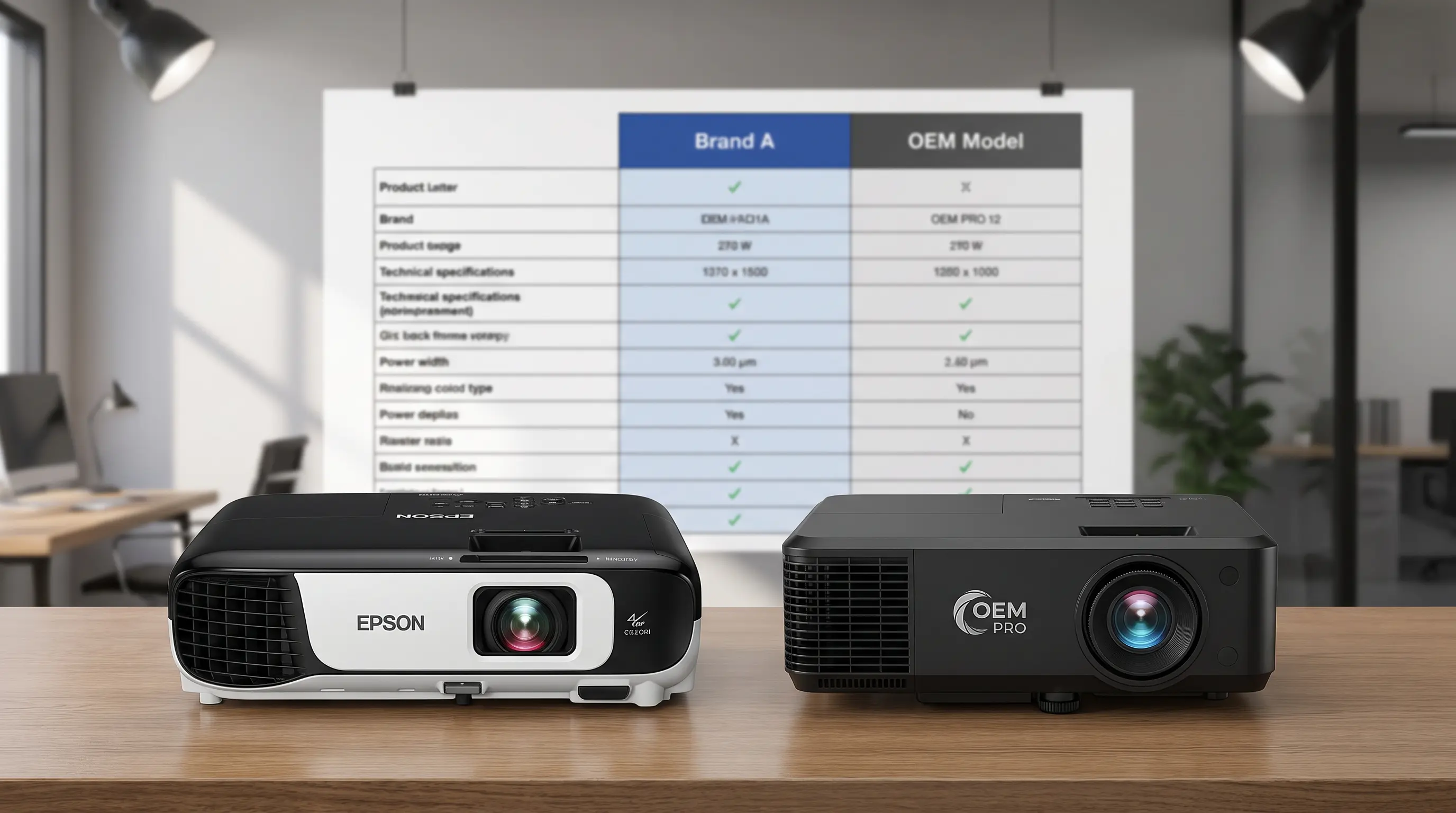
this product vs Retail XGIMI: Side-by-Side Comparison

Third pillar is noise, measured at 28 dB or below in standard mode for any product the buyer wants to position as a bedroom or living room projector, a benchmark the IEEE acoustics guidance recommends for home electronics above 1000 lumens output. Fourth pillar is the optical engine: laser phosphor display modules now reach 25,000-hour MTBF in tier-one supply, while legacy LED engines cap near 30,000 hours but lose color brightness faster. Fifth pillar is connectivity, including HDMI 2.1 with eARC, Wi-Fi 6 dual-band, Bluetooth 5.2, and USB-C PD charging on portable SKUs. We walk new OEM clients through each pillar using a worksheet during sample development.
| Decision Factor | Retail XGIMI Unit | the model |
|---|---|---|
| Boot logo and wallpapers | Stock XGIMI only | Custom artwork pre-flashed at factory |
| Packaging and manual | Multilingual retail artwork | Country-specific artwork, retail-ready |
| MOQ for new SKUs | 1 unit (Amazon or XGIMI store) | 100 units typical, 500 for ultra-short throw SKUs |
| Ex-factory unit cost (portable 1080p) | n/a — not available as component | $118–$162 depending on optical stack |
| Lead time from PO | Ships same day from Amazon | 35–55 days mass production after sample sign-off |
| Widevine L1 streaming | Pre-installed | Pre-installed via licensed bootloader |
| Warranty and RMA | XGIMI handles end-customer | Brand owner handles, OEM supports RMAs |
this option factory engagement runs on a fairly standard B2B rhythm that B2B procurement teams should plan around. Sample units for evaluation typically cost $80–$140 per piece depending on optical complexity and arrive 25–45 days after PO confirmation. PP sample sign-off triggers mass production, which itself runs another 35–55 days on 100-unit minimum orders for most portable models. For a 1000-unit run on a comparable ultra-short throw our product SKU, expect 60–80 days total from PO to ex-factory delivery.
Where a China XGIMI Alternative Factory Adds Margin You Can Recapture
Certification deserves its own timeline because FCC Part 15, CE-RED, and Energy Star testing can add 4–8 weeks if the lab queue is long, and a reputable China XGIMI alternative factory will cover the first round of pre-scan in-house. Packaging and manual artwork can be locked in parallel with tooling, which compresses overall project time. For wholesale XGIMI alternative OEM clients targeting Amazon US, we also recommend budgeting 3–4 weeks for Amazon FBA prep, including pallet labeling, poly bag, and box content documentation per Amazon's FBA Shipment Requirements. Add 10% buffer for logistics delays, especially during Q4 peak season.
When XGIMI is the reference benchmark r private label engineering tickets for buyers who already operate a brand catalog also include accessory cross-sells: a carry case, a ceiling mount, an ambient light rejection screen. Wholesale XGIMI alternative OEM accessory SKUs run on a separate 35-day production window with their own MOQ of 200 units, and we typically bundle accessories into the same shipment when the buyer's pallet plan allows. The accessory margin is where B2B buyers frequently outperform the projector margin itself, which is worth flagging during the initial scoping conversation.
Next Steps: How to Choose the Right XGIMI Alternative for Private Label
this unit development at our Shenzhen facility starts with a structured discovery call where we map the buyer's target SKU against three reference points: a benchmark XGIMI retail unit, the buyer's preferred retail price band, and the certification target region. Walk-in buyers who arrive with only a SKU idea usually leave that call with a 14-page specification sheet, a sample timeline, and a written quotation. Walk-in the device buyers who arrive with a finished spec sheet skip the discovery phase entirely and move directly into the engineering handoff within 48 hours.
Procurement Checklist for OEM Buyers
Looking beyond Dangbei specifically r private label procurement follows a tight cadence that we have refined over more than 200 OEM engagements since 2022. The standard flow: day 1–7, sample evaluation and chassis selection from our four reference platforms; day 8–21, hardware and firmware customization, including boot logo, wallpapers, and packaging artwork; day 22–30, EVT pilot run of 20 units for agency certification; day 31–55, mass production at 35-day lead time after sample sign-off; day 56–70, ocean freight from Shenzhen or Ningbo to the buyer's nominated FBA or 3PL. Sample policy is straightforward: we ship a fully configured retail sample within 5 business days at $85 per unit, refundable against the first 1,000-unit PO. Contact channel is a single named project engineer plus a WhatsApp business thread, which keeps tooling decisions off email and onto a shared BOM spreadsheet that both sides edit in real time. For B2B procurement teams evaluating an XGIMI alternative for private label partner, this cadence removes roughly three weeks of ambiguity from the typical first-order timeline.An system engineering splits into three parallel workstreams once the spec is locked. Optical workstream covers the light engine, the throw-ratio lens stack, and the cooling profile; we typically validate brightness on a Konica Minolta LS-150 luminance meter at 1 meter distance, then again at 3 meters to confirm ANSI lumen claims hold in real-room use. Electronic workstream covers the mainboard, the Android TV integration, and the licensed Widevine L1 handshake. Industrial design workstream covers the enclosure, the remote control, the gift-box artwork, and the printed user manual in the target country language. For wholesale XGIMI alternative OEM clients, we recommend concurrent tooling across all three workstreams to keep the Gantt chart inside an 80-day window.
What DataMax Recommends
Industry Context
The China XGIMI alternative category has matured into a four-vendor market where chassis selection, not hardware innovation, drives differentiation. For buyers weighing wholesale XGIMI alternative OEM commitments in 2025, the strategic question is no longer whether to private label a projector but which of the four reference platforms locks the cleanest upgrade path into 2026 laser refresh cycles.
One first sample we hand the SKU buyer is a hand-assembled EVT unit, not a polished retail mockup. We do this on purpose: the EVT reveals whether the buyer is satisfied with the spec or wants to push brightness higher, add an extra HDMI port, or swap the speaker driver. Wholesale XGIMI alternative OEM revisions after EVT stay inside the original tooling for 80% of projects we have shipped in the past 18 months. A buyer who requests a tooling-altering revision after DVT should expect both a 21-day tooling delay and a small line-stop fee, terms that are written into our master supply agreement.
