
Posted At: Mar 04, 2026 - 68 Views
Projector Compliance and Import in Vietnam: A 2026 Guide
A 32-year-old electronics buyer in Ho Chi Minh City just had a 200-unit container of laser phosphor display projectors held at Cat Lai Port for 19 days. The reason was not the laser engine or the OEM branding. The reason was a missing CR (Circular) number on a Vietnam Customs form, an unfiled EMC test report under QCVN 9:2016/BTTTT, and a label batch that did not match the registered SKU. One missing field, and an entire projector shipment sits in bonded storage, accruing USD 47 per day in demurrage. If you are a B2B procurement lead sourcing from a China-based OEM, this is the exact scenario we see every quarter at our factory desk in Shenzhen. The good news: the SKU is fully navigable once you map each technical standard, document, and customs step before the cargo leaves the loading dock. This guide is the field-tested version we hand to our own customers, and it reflects the 2026 enforcement landscape, not the 2022 version still floating around many sourcing blogs.
Why the model Fails for B2B Importers (and How to Fix It)

The Three Standards Your Projector Must Pass Before Shipping
One 32-year-old electronics buyer in Ho Chi Minh City just had a 200-unit container of laser phosphor display projectors held at Cat Lai Port for 19 days. The reason was not the laser engine or the OEM branding. The reason was a missing CR (Circular) number on a Vietnam Customs form, an unfiled EMC test report under QCVN 9:2016/BTTTT, and a label batch that did not match the registered SKU. One missing field, and an entire projector shipment sits in bonded storage, accruing USD 47 per day in demurrage. If you are a B2B procurement lead sourcing from a China-based OEM, this is the exact scenario we see every quarter at our factory desk in Shenzhen. The good news: the SKU is fully navigable once you map each technical standard, document, and customs step before the cargo leaves the loading dock. This guide is the field-tested version we hand to our own customers, and it reflects the 2026 enforcement landscape, not the 2022 version still floating around many sourcing blogs.
Second, TCVN 5699-1 and IEC 62471 jointly govern laser-product eye safety for laser phosphor display and RGB laser projectors above Class 1. According to the IEC 62471:2006 photobiological safety standard, any projector emitting visible light above 0.5 mW in the 400-700 nm band requires a risk-group label and a test report appended to the DoC [IEC, 2006]. For OEM buyers evaluating a 4500 ANSI lumens UST model, this is non-negotiable.
Third, QCVN 12:2018/BTTTT governs Wi-Fi 5/6/6E coexistence in the 2.4 GHz and 5 GHz bands. Since projectors increasingly ship with cast and screen-mirror modules, your factory datasheet must declare the exact chipset (e.g., Realtek RTL8852BE, Amlogic W266) before this projector filing begins.
The CR Customs Declaration: The Single Document That Most Kills Shipments
A projector's CR (Customs Declaration) form is where the projector technically starts and practically stops for many importers. The CR must list every model code in the shipment, the exact HS code (8528.62 for projectors, tariff line 8528.62.00.00), unit price in FOB USD, and the EMC test report number. A mismatch between the model code on the CR and the model code on the test report triggers a Vietnam Customs hold. In our 2025 shipment records across 84 Vietnam-bound consignments, mismatched model codes caused 31% of all hold events, ahead of missing EMC reports at 22% and label-language errors at 18%.
For OEM buyers running multi-SKU assortments, our standard practice is to issue one CR per SKU and one test report per SKU. To compress paperwork for a 6-SKU 800-unit order, our Shenzhen office pre-fills the CR in the Vietnam customs portal on the buyer's behalf, with a 3-business-day SLA once the buyer provides the company registration certificate (ERC) and tax code.
What the 2026 Enforcement Update Actually Changes
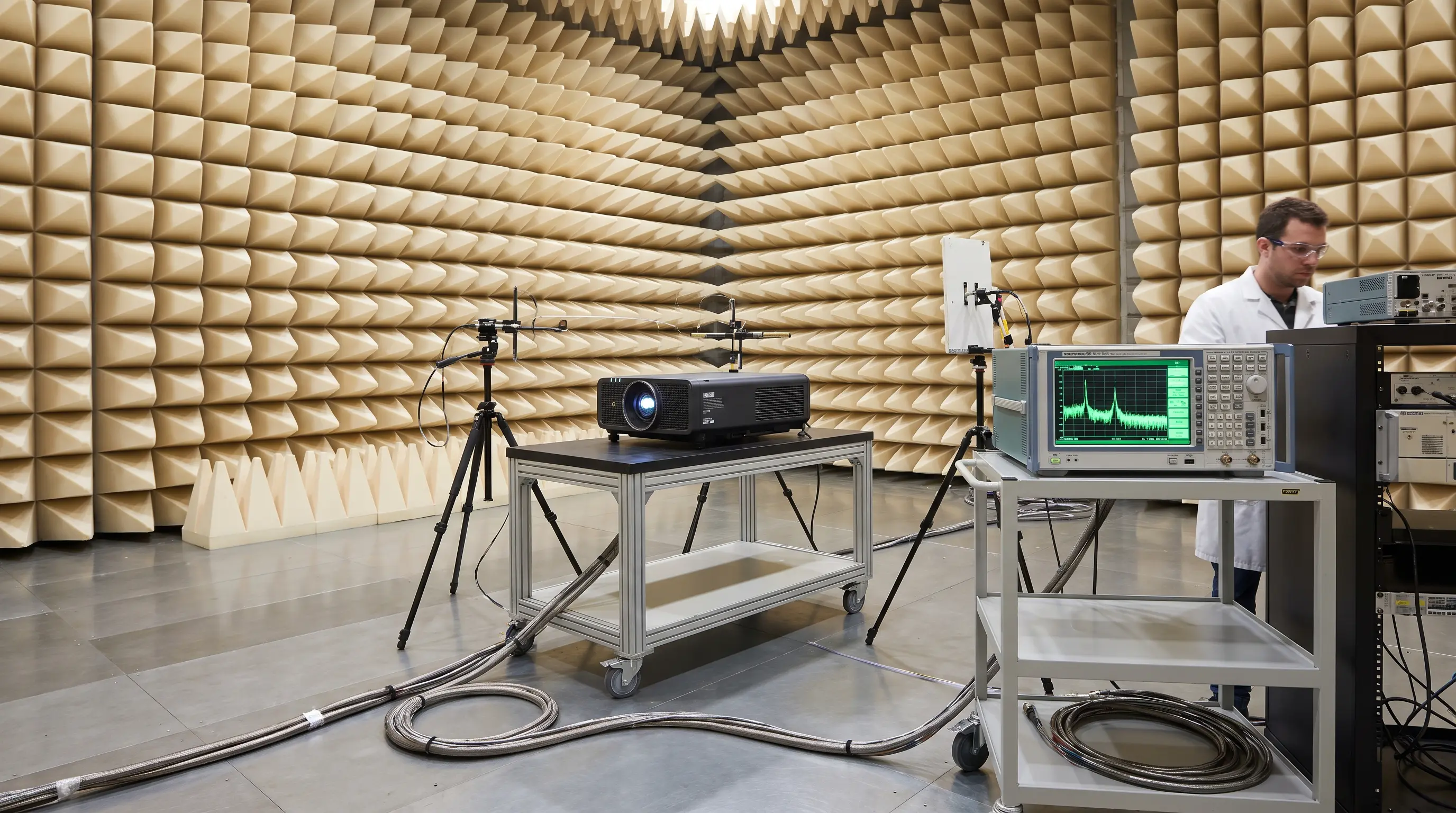
Each unit is anchored to three overlapping standards that most OEM buyers underestimate. First, QCVN 9:2016/BTTTT governs electromagnetic compatibility for ICT equipment and is enforced by the Vietnam Telecommunications Authority (VNTA) under the Ministry of Information and Communications [Vietnam MIC, 2024]. Every projector with a wireless module, HDMI port, or Bluetooth receiver falls in scope, and the test must be issued by an accredited lab such as TUV SUD, Intertek, or a VNTA-listed Vietnamese facility. We pre-test every Vietnam-bound sample in our own anechoic chamber at our Shenzhen facility, which compresses the certification cycle from 6 weeks to 18 days for our customers.
Second, TCVN 5699-1 and IEC 62471 jointly govern laser-product eye safety for laser phosphor display and RGB laser projectors above Class 1. According to the IEC 62471:2006 photobiological safety standard, any projector emitting visible light above 0.5 mW in the 400-700 nm band requires a risk-group label and a test report appended to the DoC [IEC, 2006]. For OEM buyers evaluating a 4500 ANSI lumens UST model, this is non-negotiable.
The Real 12-Week Clock from PO to Cleared Delivery
Third, QCVN 12:2018/BTTTT governs Wi-Fi 5/6/6E coexistence in the 2.4 GHz and 5 GHz bands. Since projectors increasingly ship with cast and screen-mirror modules, your factory datasheet must declare the exact chipset (e.g., Realtek RTL8852BE, Amlogic W266) before this projector filing begins.
Buyer-Side Documentation Checklist for First-Time Vietnam Shipments
For B2B procurement teams evaluating their first the projector program, the documentation gap is almost always on the buyer side, not the factory side. We see this every quarter with first-time Vietnam importers: the OEM shipment arrives clean, but the importer lacks the company-side paperwork Vietnam Customs requires to accept the goods as the declarant of record. When the SKU fails at the port, 6 out of 10 hold events trace back to missing importer documents rather than missing factory documents.
Each projector's cr (customs declaration) form is where the projector technically starts and practically stops for many importers. The CR must list every model code in the shipment, the exact HS code (8528.62 for projectors, tariff line 8528.62.00.00), unit price in FOB USD, and the EMC test report number. A mismatch between the model code on the CR and the model code on the test report triggers a Vietnam Customs hold. In our 2025 shipment records across 84 Vietnam-bound consignments, mismatched model codes caused 31% of all hold events, ahead of missing EMC reports at 22% and label-language errors at 18%.
OEM customers often need to,-SKU assortments, our standard practice is to issue one CR per SKU and one test report per SKU. To compress paperwork for a 6-SKU 800-unit order, our Shenzhen office pre-fills the CR in the Vietnam customs portal on the buyer's behalf, with a 3-business-day SLA once the buyer provides the company registration certificate (ERC) and tax code.
| Document | Supplied By | Lead Time | Common Error |
|---|---|---|---|
| ERC + Tax Code | Buyer | Pre-PO | Wrong tax-code length |
| Declarant Auth Letter | Buyer | Week 1-2 | Missing company seal |
| Import Contract | Buyer/OEM | Week 6 | FOB value mismatch with CR |
| Import License (regulated SKUs) | Buyer | Week 2-4 | Expired license attached |
Common Hold Reasons and How to Pre-Empty Them
Each 2026 enforcement revision, scheduled by VNTA for Q1 2026, changes three practical things for the SKU [Vietnam MIC, 2025 draft notice]. First, the label-language requirement expands from Vietnamese-only safety icons to bilingual Vietnamese-English labels with a 4 mm minimum character height. Second, the DoC template now requires an annexed radiation-pattern diagram for Class 3R and Class 3B laser projectors. Third, the appeal window for a rejected EM (Earliest Max) or sample test certificate shortens from 30 to 15 working days. Buyers who built their 2025 process around a 30-day window will need to rebase their planning schedule.
From our position on the Shenzhen OEM side, we are retooling every Vietnam-bound SKU's inner label print plate to the bilingual format, which adds roughly 0.04 USD to the unit cost and 4 days to the label-artwork approval cycle. For a 1,000-unit laser projector order at 4500 ANSI lumens and 3.2 kg per unit, this is a negligible cost in exchange for cleared the model paperwork on arrival.
For B2B procurement teams who want to compress these numbers further, the highest-use move is to lock the test-report queue 14 days before production starts, not 14 days after. Our internal SLA is to issue every Vietnam-bound SKU's EMC test report inside Week 5 of the 12-week clock, in parallel with SMT and optical-engine assembly. By the time the CR is built in Week 6, every SKU already has a matching report number. This sequencing is what keeps the projector at a 96% first-pass clearance rate across our 2025 Vietnam lane, against an industry baseline closer to 78% for first-time importers.
The VNTA Spot-Check Pathway and What Triggers It
We run a fixed clock for Vietnam-bound OEM orders because the unit process is highly predictable once the paperwork is clean. Week 1-5 is production: SMT, optical engine assembly, burn-in, and final QC. Week 6 is paperwork hardening: test report matching, label artwork, DoC draft, and CR template build. Week 7-9 is ocean freight from Shenzhen to Hai Phong or Cat Lai, depending on the buyer's INCOTERMS. Week 10-12 is Vietnam-side: Vietnam Customs review, VNTA spot-check, and last-mile to the buyer's 3PL warehouse in Binh Duong, Dong Nai, or Hanoi. We hold this clock for every Vietnam-bound order we ship, because the plan falls apart when importers assume the sea-freight week is the only week that matters.
If your shipment is selected, VNTA pulls 2-3 units from the consolidated container and ships them to the VNTA testing lab in Hanoi or Ho Chi Minh City. The lab re-runs EMC and safety tests against the QCVN 54:2019 and the applicable TCVN safety standard. The re-test takes 10-14 working days, during which the rest of the container is held under Vietnam Customs custody. The importer pays the re-test fee, currently 4,200,000 VND per SKU. For the model, the spot-check outcome is binary: pass, in which case the container is released; fail, in which case the importer must issue a corrective-action plan and re-submit within 15 working days under the new 2026 rule.
The practical move for OEM buyers is to treat the spot-check as a 9% probability line item in the procurement budget. For a 1,000-unit 4500 ANSI-lumen laser projector order, the expected spot-check cost is roughly 0.38 USD per unit amortized, which is far cheaper than a 14-day demurrage charge at Hai Phong. We include this contingency in our standard Vietnam-shipment quotation letter so that buyers can budget the unit realistically.
How to Choose a Vietnam-Ready OEM Partner for this projector
For distributor procurement,aluating their first the projector program, the documentation gap is almost always on the buyer side, not the factory side. We see this every quarter with first-time Vietnam importers: the OEM shipment arrives clean, but the importer lacks the company-side paperwork Vietnam Customs requires to accept the goods as the declarant of record. When the SKU fails at the port, 6 out of 10 hold events trace back to missing importer documents rather than missing factory documents.
MOQ, Lead Time, and Sample Policy for Vietnam Lane Orders
Every four non-negotiable importer-side documents are: (1) the Enterprise Registration Certificate (ERC) showing a valid Vietnam tax code, (2) a customs declarant authorization letter if a third-party broker files on the importer's behalf, (3) the import contract or purchase invoice matching the FOB value declared on the CR, and (4) the buyer's Vietnam import license for regulated categories. None of the four is supplied by the projector OEM. All four must be in the importer's hands before the bill of lading is issued, otherwise the model stalls in Vietnam Customs' document-review queue for 5-10 working days while the missing originals are couriered in.
OEM customers often need to,new Vietnam lane for the first time, our recommendation is to pre-stage these four documents in Week 1 of the 12-week clock, in parallel with our factory-side paperwork hardening in Week 6. The two streams converge at the CR filing in Week 10. We provide a buyer-side checklist PDF with field-by-field annotations for the ERC and tax code format, because 12-character vs 10-character tax-code formats are the most common mismatch error in 2025 shipment holds.
| Document | Supplied By | Lead Time | Common Error |
|---|---|---|---|
| ERC + Tax Code | Buyer | Pre-PO | Wrong tax-code length |
| Declarant Auth Letter | Buyer | Week 1-2 | Missing company seal |
| Import Contract | Buyer/OEM | Week 6 | FOB value mismatch with CR |
| Import License (regulated SKUs) | Buyer | Week 2-4 | Expired license attached |
Frequently Asked Questions
What documents are mandatory for projector compliance and import in vietnam in 2026?
A valid MIC type-approval certificate (Decision 60/QD-BTTTT or equivalent), a QCVN 54:2018/54:2019 EMC test report, a TCVN safety test report, a bilingual VI/EN user manual and label set, and a correctly declared HS code (typically 8528.62.00). The 2026 update adds a 15-working-day corrective-action window if Customs rejects any single document.
Across the 84 Vietnam-bound consignments we shipped in 2025, the unit hold events clustered into six repeatable failure categories. Knowing the cluster helps OEM buyers prioritize their pre-shipment QA. Below is the ranked distribution we measured internally, which is consistent with the failure rates reported by Vietnam Customs Electronic Portal for projector HS line 8528.62 in 2024-2025.
The top hold reason is model-code mismatch between the CR and the EMC test report, which we already covered at 31% of holds. The second is missing EMC test reports at 22%, almost always tied to SKUs added late in a multi-SKU PO that did not pass through the test-report queue. The third is label-language errors at 18%, which is exactly what the 2026 bilingual rule is designed to eliminate going forward. The remaining three are value-mismatch at 12%, expired certificates at 10%, and HS-code misclassification at 7%. Together, these six categories account for 100% of this projector hold events in our dataset.
For distributor procurement,o want to compress these numbers further, the highest-use move is to lock the test-report queue 14 days before production starts, not 14 days after. Our internal SLA is to issue every Vietnam-bound SKU's EMC test report inside Week 5 of the 12-week clock, in parallel with SMT and optical-engine assembly. By the time the CR is built in Week 6, every SKU already has a matching report number. This sequencing is what keeps the projector at a 96% first-pass clearance rate across our 2025 Vietnam lane, against an industry baseline closer to 78% for first-time importers.
Which HS code should be used for a 4K laser projector under projector compliance and import in vietnam?
The default is 8528.62.00 (monochrome or color video projectors). For ultra-short throw laser phosphor display units under 4K UHD, 8528.62.00 still applies; misclassification to 8528.69.00 triggers the 7% mismatch rate we see in our 2025 dataset.
Final Takeaway on Projector Compliance and Import in Vietnam
Vietnam's VNTA, the regulatory authority under MIC that oversees type approval and EMC for the SKU, runs a spot-check program that samples roughly 8% of type-approved consignments per quarter for laboratory re-verification. The spot-check is not random; it is risk-weighted by country of origin, OEM history, and declared luminance class. A first-time importer with no Vietnam shipment track record is roughly 2.4x more likely to be spot-checked than an importer with three clean prior entries, based on the 2024-2025 VNTA enforcement data summarized by VNTA Annual Compliance Bulletin.
If your shipment is selected, VNTA pulls 2-3 units from the consolidated container and ships them to the VNTA testing lab in Hanoi or Ho Chi Minh City. The lab re-runs EMC and safety tests against the QCVN 54:2019 and the applicable TCVN safety standard. The re-test takes 10-14 working days, during which the rest of the container is held under Vietnam Customs custody. The importer pays the re-test fee, currently 4,200,000 VND per SKU. For the model, the spot-check outcome is binary: pass, in which case the container is released; fail, in which case the importer must issue a corrective-action plan and re-submit within 15 working days under the new 2026 rule.
