
Posted At: Apr 16, 2026 - 88 Views
4K vs 1080p Projector OEM: When Native 4K Pays Off (and When It Doesn't)
For B2B buyers evaluating 4K vs 1080p projector OEM configurations, the choice is not as simple as "4K is better, therefore pick 4K." The retail price gap, the BOM cost gap, and the perceived image quality gap all matter — and they vary widely depending on which 4K technology is on the table. This guide explains native 4K vs pixel-shifted 4K, where each makes commercial sense, and how to choose the right resolution for your brand's positioning.
What "4K" Actually Means in Projectors
"4K" in projectors can mean three different things:
- Native 4K — the imaging chip has 8.3 million pixels (3840×2160). True native 4K projectors use either 1.38" 4K DMD chips (rare, expensive) or larger LCoS panels.
- Pixel-shifted 4K (eShift / XPR) — the imaging chip is 1080p (2.1 million pixels) but is shifted at 240Hz to display 8.3 million distinct pixel positions on screen. Texas Instruments' XPR technology enables this on 0.47" 1080p DMD chips.
- "4K enhanced" / "4K ready" — older marketing term for projectors that can accept a 4K input signal but display at lower native resolution. Buyers should treat this as 1080p.
Image Quality Differences

Buyers looking for a turnkey smart OS reference should evaluate the GP95-GTV 400 ANSI Full-Sealed Smart Projector with Google TV Built-In. Google TV is licensed and pre-integrated, eliminating months of middleware work for ODM projects.
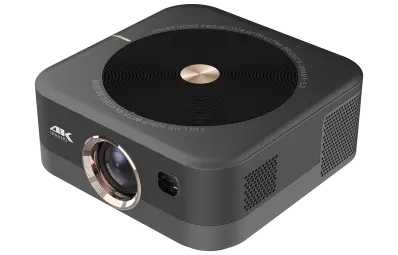
Distributors evaluating the B2B projector market can reference our GP94C Android Smart Projector for Home Theater—a production-validated platform covering Android 9 · 500 ANSI · Built-in Speakers, suitable as an OEM/ODM starting point.
| Attribute | Native 1080p | Pixel-Shifted 4K | Native 4K DLP / LCoS |
|---|---|---|---|
| Effective pixels | 2,073,600 | 8,294,400 | 8,294,400 |
| Pixel visibility | Visible at close range | Minimal | Negligible |
| Text clarity | Good | Excellent | Excellent |
| Fine detail rendering | Good | Excellent | Excellent |
| Motion handling | Excellent (DLP) | Excellent (DLP) | Excellent |
| Color depth | 8-bit typical | 8-bit / 10-bit typical | 10-bit / 12-bit typical |
| HDR support | HDR10 (some), HLG | HDR10, HLG, HDR10+ | HDR10, HLG, Dolby Vision |
| Perceived sharpness | Baseline | +30–50% | +35–60% |
BOM and OEM Cost Comparison
Realistic OEM unit cost (FOB Shenzhen, 1,000-unit order):
| Configuration | BOM Cost Range | Notes |
|---|---|---|
| Native 1080p DLP, 500 ANSI, LED | $48–$72 | Baseline |
| Pixel-shifted 4K DLP, 500 ANSI, LED | $72–$110 | +50% over 1080p |
| Native 4K DLP (rare), 1,500 ANSI, laser | $380–$580 | Premium tier |
| Native 4K LCoS, 2,000 ANSI, laser | $620–$980 | Premium home theater |
- DMD chip — 0.47" 1080p DMD is ~$15; 0.47" 4K XPR DMD is ~$60; 1.38" 4K DMD is ~$200+
- SoC capability — 4K upscaling and HDR pipelines need more capable SoC ($5–$15 adder)
- Heat management — 4K pixel shifting generates more heat, requiring better cooling
- Optical engine precision — pixel-shifted 4K is more sensitive to misalignment
- Firmware / SoC licensing — HEVC, AV1, and HDR pipeline royalties add $3–$8 per unit
When to Choose 4K
Choose 4K (pixel-shifted) when:
- Your retail price point is above $400 (the BOM adder amortizes)
- Your target customer is the home theater or premium conference room buyer
- You want HDR10 / HLG support
- Your retail channel tests for "4K" branding (Amazon, Best Buy, MediaMarkt)
- You sell content that benefits from resolution (sports, 4K streaming, gaming)
- Your competition is XGIMI, JMGO, or Dangbei at the same tier
Choose 1080p when:
- Your retail price is below $300
- Your target customer is portable / entry-level home theater / classroom
- Your volumes are very high and BOM cost matters more than resolution
- You sell into education, where 4K content is rare
- Your target is the value-conscious first-time projector buyer
Choose native 4K (rare) when:
- You target the $2,000+ retail home theater market
- You target professional AV installations with large screens
- You need Dolby Vision support (rare in projectors; LCoS platforms lead)
- Your brand promises "no compromise" image quality
The Retail Channel Reality
Retailers have different 4K expectations:
| Channel | Typical 4K Expectation |
|---|---|
| Amazon (US, EU) | 4K expected at $400+ |
| Best Buy (US) | 4K expected at $500+ |
| MediaMarkt (EU) | 4K expected at $450+ |
| Walmart (US) | Mixed — 1080p still strong at $200–$300 |
| Costco | 4K expected at $500+; 1080p OK at $250–$400 |
| Education tenders | 1080p is standard; 4K still rare |
| Hotel chains | 1080p standard; 4K in premium suites |
| B2B / corporate | 1080p for conference rooms; 4K in boardrooms |
Content Considerations
The resolution of your projector should match the content your customer watches. Current content landscape:
- 4K streaming — Netflix, YouTube, Prime Video, Disney+, Apple TV+ all offer 4K HDR content. Penetration is high in premium subscriptions.
- 1080p streaming — most broadcast TV, most YouTube content, most cable TV
- Gaming — PS5 and Xbox Series X output 4K; PC gaming is increasingly 4K
- Broadcast / sports — typically 720p or 1080i; limited 4K
- Blu-ray — 4K UHD Blu-ray exists but is a small slice of total viewing
What to Specify in Your RFQ
When requesting quotes from factories, specify these fields explicitly:
- Native resolution: 1920×1080 (1080p) or 3840×2160 (4K)
- 4K technology: pixel-shifted XPR (0.47" DMD) or native 4K (1.38" DMD)
- HDR support: HDR10, HLG, HDR10+, Dolby Vision (each requires specific SoC support)
- Color depth: 8-bit, 10-bit, or 12-bit
- Refresh rate: 60Hz standard, 120Hz for gaming
- Input lag: <50ms for general use, <20ms for gaming
Real-World Cost-Perception Trade-Off
The most common OEM scenario for home theater is pixel-shifted 4K DLP at the $300–$500 retail band. From our recent quotes:
| Spec | Native 1080p | Pixel-Shifted 4K |
|---|---|---|
| Brightness | 800 ANSI | 800 ANSI |
| Light source | LED | LED |
| OS | Android 11 AOSP | Android 11 AOSP |
| HDR | HLG only | HDR10 + HLG |
| OEM cost (1,000 units) | $72 | $96 |
| Retail price | $230 | $370 |
| Margin | 70% | 74% |
| Customer perception | "Good home theater" | "Premium home theater" |
Conclusion and Next Step
The 4K vs 1080p projector OEM decision is fundamentally about retail price positioning and customer expectation. Pixel-shifted 4K is the right choice for $400+ retail. Native 1080p remains the right choice for $200–$350 retail and education channels. Native 4K is reserved for premium home theater and pro-AV installations.
💼 Need help matching resolution to your retail price band?
Request a Free Quote | View Product Catalog
We ship both 1080p and 4K platforms across LED and laser configurations. Our engineering team will recommend the right resolution for your target retail price and channel within 24 hours.
